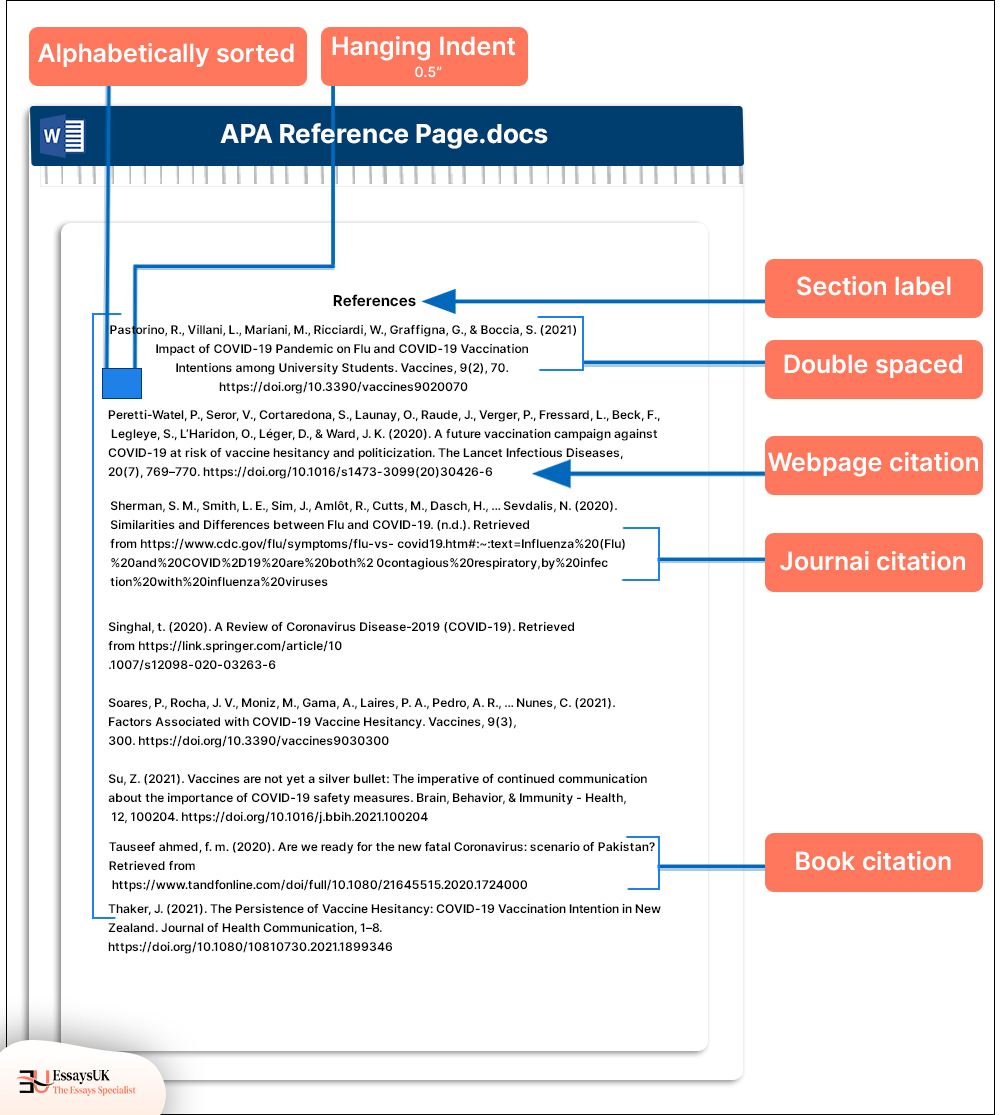
The reference page is a crucial part of any APA-formatted academic paper. It provides full citations for all the sources you referenced in the body of your work, ensuring academic transparency and proper attribution.
A well-formatted reference page not only strengthens your credibility but also allows readers to locate your sources quickly and easily.
The reference page begins a new page immediately after the main body of your paper and before any appendices. APA 7th Edition has strict formatting requirements that must be followed.
Here are some basic APA formatting rules:
Example of a reference page heading:
Arranging your references alphabetically is not always simple. Here’s how APA referencing style requires you to alphabetise entries:
The surname of the first author determines the position.
EXAMPLE
Adams, R.
precedes
Benson, L.
When a source has no author, the title moves to the author position. Ignore A, An, and The at the beginning of titles, and alphabetise by the first meaningful word.
EXAMPLES
Order them chronologically, starting with the earliest.
EXAMPLE
Brown, A. (2017)
Brown, A. (2020)
Brown, A. (2022)
Add a, b, and c after the year.
EXAMPLES
Thomas, J. (2021a)
Thomas, J. (2021b)
Sort by the second author’s last name.
EXAMPLE
Carter, L., & Benson, R.
Carter, L., & Wright, A.
The reference list is generally ordered automatically by word processing tools such as Word or Google Docs and citation generators.
Unfortunately, if you reference multiple works by the same author or works by authors with the same last name, ordering becomes more difficult. Manual adjustments are sometimes required.
It is recommended to add only the sources you have cited in the main body using in-text citations.
Include:
Do not include:
This ensures your reference page contains only the sources relevant to your academic argument.
Some instructions require an annotated bibliography, which includes a brief explanation or evaluation of each source. Here are some tips to format annotations:
Annotation content may include a summary of the source, an evaluation of its credibility, an explanation of how the source supports your research, and strengths and limitations.
EXAMPLE STRUCTURE
Smith, J. (2021). Climate Change behaviour. Oxford University Press.
This book explores…
Annotations help demonstrate your understanding of each source and how it fits into your research.
Here are the simplified examples of APA-formatted reference entries that follow conventions for punctuation, capitalisation, and italics:
Book Reference:
Smith, J. A. (2020). Understanding psychology. HarperCollins.
Journal Article:
Lopez, R., & Carter, M. (2021). Ethical decision-making in AI. Journal of Digital Studies, 18(3), 112-125. https://doi.org/10.1234/jds.2021.018
Website:
World Health Organisation. (2022, April 5). Mental health and well-being. https://www.who.int/news-room
Report:
National Education Board. (2020). Annual education review 2020. Government Publications Office.
COMMON REFERENCE PAGE MISTAKES TO AVOID
Avoiding these mistakes will keep your reference page polished and professional.
Start with the bold, centred heading “References”, then list entries alphabetically. Use double-spacing, a 0.5-inch hanging indent, and follow APA rules for each source type, like author, year, title, source, and DOI/URL.
Yes. Every line, including reference entries, annotations, and titles, must be double-spaced.
Move the title to the author position and alphabetise by the first meaningful word, ignoring a, an, and the. Provide year, title, and source information as usual.
No. Private conversations, texts, emails, or interviews that cannot be retrieved by readers are cited only in-text and do not appear in the reference list.
A hanging indent means the first line is flush left, and all following lines are indented by 0.5 inches. In Word or Google Docs, use paragraph → indentation → hanging.
You May Also Like