Home > Knowledge Base > APA Referencing Style > How to Write an Abstract in APA Format | A Detailed Guide

How to Write an Abstract in APA Format | A Detailed Guide

Published by at February 6th, 2022 , Revised On April 13, 2026

An abstract is a brief overview of your entire research paper or dissertation. In APA referencing style, it is typically 150-250 words. It summarises:

✔️The research problem or purpose

✔️The methods or approach

✔️The key results

✔️The major conclusions or implications

When is an APA abstract written?

An abstract is the most compact, yet informative part of your scholarly work. Although it appears at the beginning, you write it after completing the full dissertation or research paper.

APA Abstract Template

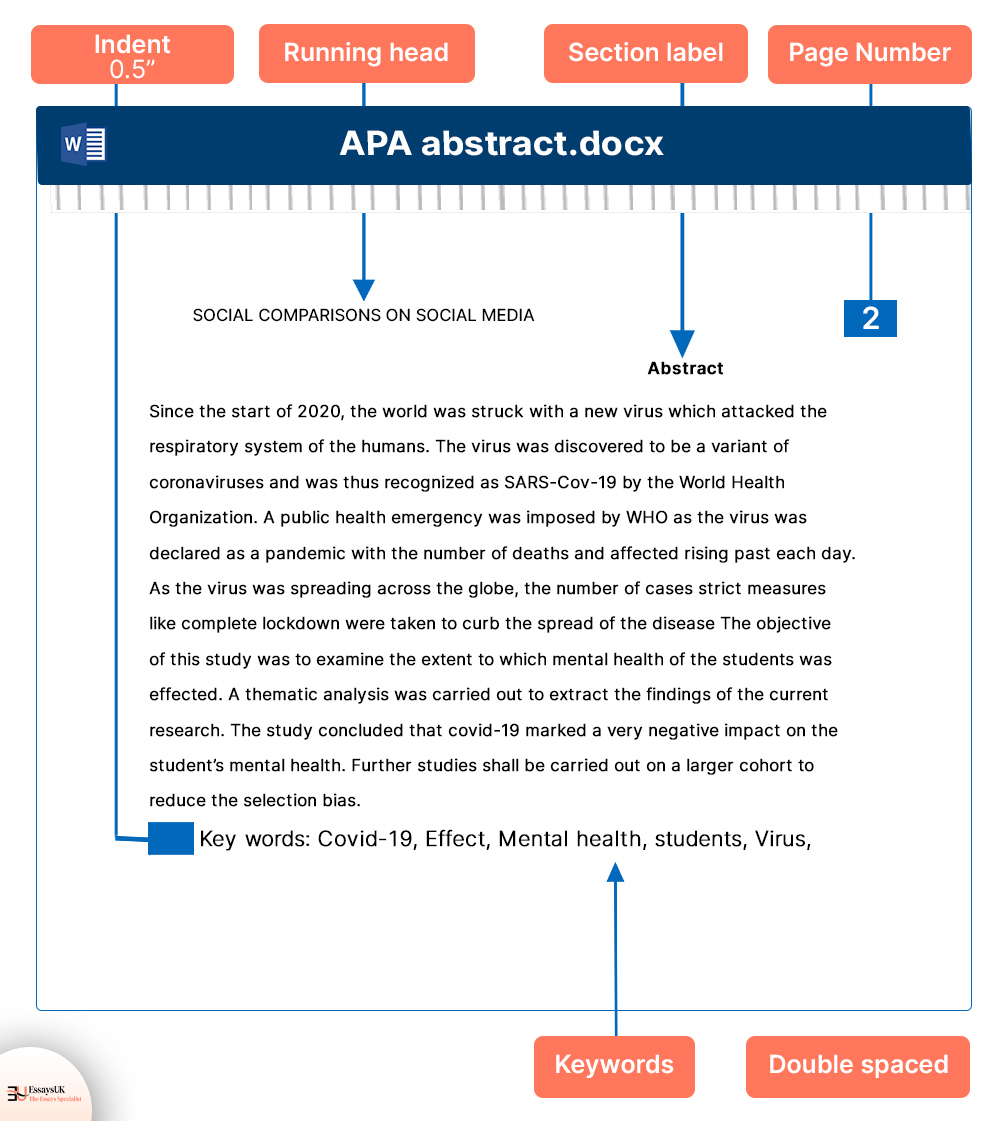
Here is the template of an APA template that you can view or download:

APA Abstract Example

An example of an APA abstract is given below: 

This study investigates the relationship between sleep quality and memory performance among adults aged 18-25. A mixed-method approach was used, combining surveys with cognitive recall tests. Findings show that participants with higher sleep quality performed significantly better in memory-based tasks. The results highlight the importance of sleep hygiene in cognitive functioning. Future research should examine long-term behavioural interventions to improve sleep patterns. 

Keywords: sleep quality, memory recall, cognitive performance, young adults, behavioural health

How to Write an APA Abstract? 

APA abstracts follow a predictable and structured pattern. Here are the essential steps you can follow to write an APA abstract: 

Step 1: Start with the purpose of your research

The first step is to explain your research objective. Begin with 1-2 sentences explaining the main topic, the central objective, the research problem, and the guiding research question or hypothesis. 

For example, “This study examines the relationship between social media usage and academic performance among university students”

Step 2: Summarise your methodology

The next step is summarising your methodology. State the approach you used, including: 

  • Research design (qualitative, quantitative, mixed-method)
  • Participants or sample
  • Tools, instruments, or data collection methods

For example, “a quantitative survey was conducted with 320 undergraduate students using structured questionnaires”

Step 3: Present your key findings

After you have summarised your methods, present your key findings. Summarise your main results without giving excessive detail or statistics. 

For example, “Results indicated a significant negative correlation between excessive social media use and overall academic performance”

Step 4: Provide the main conclusion or implications

You have explained your results; now, provide the main conclusion. Explain what your results mean and why they matter to your research study. 

For example, “The findings suggest that reducing online engagement could improve students’ focus and academic outcomes”

Step 5: Add recommendations or future research directions

An APA abstract must also include recommendations for other researchers or students. So, add 1-2 recommendations to allow them to replicate our study.

What are the steps to write an APA abstract? 

  1. Start with the purpose of your research
  2. Summarise your methodology
  3. Present your key findings
  4. Provide the main conclusion or implications
  5. Add recommendations or future research directions

Why Is the Abstract Important?

A well-written abstract plays several important roles: 

  • It helps readers quickly assess your research

The primary benefit of an abstract is ease in assessing your research. It allows readers, instructors, journal editors, and researchers to decide whether the paper is relevant to their needs. They understand what is discussed without scrolling through the whole document. 

  • It increases discoverability

Writing a well-written abstract also increases its discoverability. When abstracts and keywords are indexed by academic databases, such as Google Scholar or PubMed, they are accessed by global users who can find information about your methods and results. 

  • It demonstrates clarity and academic skill

Writing an abstract requires a certain level of subject knowledge and academic writing skills. An organised, concise abstract reflects the writer’s ability to summarise complex information efficiently. It also guides readers about the steps that the writer has taken to write the abstract.

What are the benefits of an APA abstract?

A well-written APA abstract helps readers quickly assess your research, increases discoverability, and demonstrates your clarity and academic skill.

Formatting of an APA Abstract

APA 7th Edition has precise rules for formatting the abstract. Here are the guidelines that you can follow to format your APA abstract efficiently: 

  • Add page number 2 in the top-right header. 
  • Professional papers include a running head on the left; student papers do not. 
  • Set 1-inch margins on all sides. 
  • Write “Abstract” in bold and at the top centre of the page.
  • Do not indent the first line of the paragraph.
  • Use a readable font, such as Times New Roman 11, Arial 11, and Calibri 11. 
  • Try to complete the abstract within 250 words.
  • Write the label “Keywords:” in the next line.
  • Italicised the word “Keyword”.
  • Write keywords in lowercase letters and in alphabetical order.
  • Use commas to separate each keyword.

Choosing Keywords for an APA Abstract

At the end of the abstract, you can provide some keywords for the readers or research that will be used for indexing if your work is published in a database. Keywords help databases categorise your paper. APA recommends 3-5 relevant keywords. 

They will help people search your paper online. Here’s how you can choose strong keywords: 

  • Tip 1: Select the keywords that are relevant to your topic. 
  • Tip 2: Include methodology-related keywords. 
  • Tip 3: Add terms related to your sample population, such as adolescents or teachers. 

Formatting keywords: 

  • Write keywords: (italicised)
  • Place keywords on the same line
  • Separate each keyword with commas
  • Use lowercase letters unless it’s a proper noun
  • List them in alphabetical order

Common Mistakes to Avoid When Writing an APA Abstract

Here are the common mistakes students can make when writing an APA abstract: 

❌Adding citations: Abstracts must be written in your own words and should not include references. 

❌Writing long, detailed results: Keep the abstract concise and avoid complex statistics. 

❌Using informal language: Maintain a formal academic tone. 

❌Exceeding the word limit: APA recommends 150-250 words. 

❌Including abbreviations without context: Spell out acronyms the first time you use them. 

What are the tips for writing a strong APA abstract?

  • Write the abstract after completing your paper. 
  • Keep the sentences short and direct. 
  • Focus on the most essential information. 
  • Avoid unnecessary objectives and filler phrases. 
  • Reread your abstract for clarity and conciseness. 
  • Use active voice where possible.

Frequently Asked Questions

The APA 7th Edition recommends an abstract of no more than 250 words. However, always check your journal or instructor’s specific requirements. 

The abstract is written on page 2, right after the title page and before the introduction.

No. The abstract must be written in your own words. It should focus on your own research content without citations or quotes

No. APA 7 requires running heads only for professional papers unless your instructor specially asks for one. 

APA recommends including 3-5 keywords below the abstract to improve indexing and discoverability. 

About Grace Graffin

Avatar for Grace GraffinGrace has a bachelor's and a master's degree from Loughborough University, so she's an expert at writing a flawless essay at Essays.uk. She has worked as a professional writer and editor, helping students of at all academic levels to improve their academic writing skills.

You May Also Like