Home > Knowledge Base > APA Referencing Style > How to Write an APA Style Table of Contents?

How to Write an APA Style Table of Contents?

Published by at February 6th, 2022 , Revised On April 13, 2026

While it is widely used in dissertations, theses, long research projects, and academic reports, a Table of Contents is not a mandatory component of the APA 7th Edition. However, it helps readers navigate your document easily and understand the organisation of your work. 

Whether required by your institution or added for clarity, an APA-style table of contents must follow specific formatting, heading levels, indentation rules, and consistent styling.

Is a table of contents required in APA style?

APA 7th Edition does not require a table of contents in the standard research papers or student assignments. However, it is often required in:

  • Dissertations and theses
  • Capstone projects
  • Research Reports
  • University submissions with strict formatting guidelines
  • Professional manuscripts with multiple sections

Always check your instructor’s or institution’s requirements.

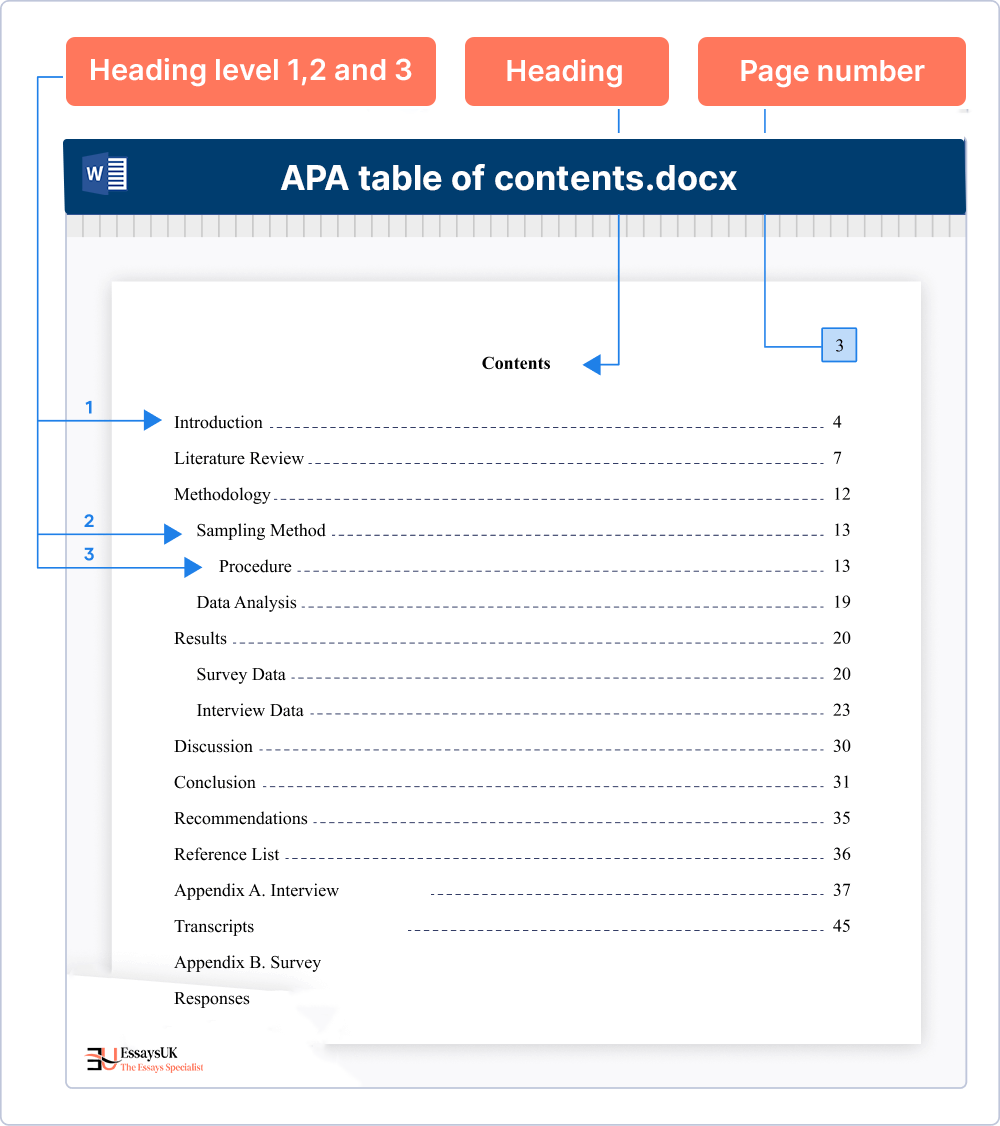
Example Structure of an APA-Style Table of Contents

A general example of an APA-style table of contents is given below:
image

General APA Formatting Guidelines for a Table of Contents

Even though APA doesn’t provide a dedicated Table of Contents format, there are widely accepted APA formatting rules and guidelines that align with its overall style conventions. Here are the guidelines that you can follow: 

Placement of the table of contents

The table of contents appears on a separate page, usually after the abstract and before the introduction

Title formatting

Use the title “Contents” or “Table of Contents”. Make it centred, bold, title case, and position it at the top of the page. 

Font and size

Use the same font as the rest of your paper, such as Times New Roman 12, Arial 11, and Calibri 11. Consistency is essential in APA style. 

Double spacing

The entire table of contents must be double-spaced, just like the rest of the document.

What are the guidelines for the APA table of contents?

Here are some guidelines that you can easily follow:

  • The table of contents appears on a separate page
  • Make it centred, bold, title case, and position it at the top of the page
  • Use the same font as the rest of your paper
  • The entire table of contents must be double-spaced

Heading Levels to Include in Your Table of Contents

You can utilise up to five levels of headings in APA Style, each with its unique formatting style. Not all papers use all levels. 

All level 1 and 2 headers should be left-aligned and displayed as plain text in the table of contents. It is optional to include lower-level headers in the table of contents. For each level, add an extra indent. If you have a lot of headings in your text, you may not be able to include them all.

HEADING INDENTATION EXAMPLE

Chapter Title (Level 1)

              Subheading 1.1 (Level 2)

              Subheading 1.2 (Level 2)

                           Sub-subheading 1.2.1 (Level 3)

Your table of contents should not be more than two pages long in total. If your paper has too many lower-level headings, exclude those at level 3 or lower. 

APA Heading Styles You Should Use in Your Document

To create a clean, functional table of contents, ensure your headings are correctly formatted using APA conventions. Here are the heading styles that you can prominently use:

Heading Styles Formatting
Level 1 Centred, bold, title case
Level 2 Left-aligned, bold, title case
Level 3 Left-aligned, bold, italic, title case
Level 4 Indented, bold, title case, ending with a period
Level 5 Indented, bold, italic, title case, ending with a period

The correct heading format is essential because Microsoft Word uses heading styles to generate your table of contents automatically.

How to Create an APA Table of Contents in Microsoft Word?

The easiest and most accurate way to create a table of contents is to use Microsoft Word’s automatic Table of Contents tools. Follow these steps: 

Step 1: Format all headings correctly

First, read over your text and make sure that each level of heading follows the APA Style guidelines. Then, on the Home tab at the top, alter the heading styles:

  • A level 1 heading should be highlighted.
  • Right-click the Heading 1 in the Styles panel. 
  • Choose Update Heading 1 to Match Selection from the drop-down menu.

Carry out the same procedure for each heading level, like Heading 2, Heading 3, etc. After that, you can use the heading styles to easily change more headings. Before you continue, check that all headings have the correct style. 

Step 2: Insert the TOC title

You may now create a table of contents. Go to the page where you want your table of contents. Write the title “Contents” first (in the style of a level 1 heading). Centre and bold the title. 

Step 3: Add the automatic table of contents

Place the cursor two lines below the title. Then, go to the References tab, and select Custom Table of Contents from the Table of Contents menu. 

Select how many levels of heading you want to include (at least two) under Show levels in the pop-up window, then click OK. Based on your existing headers and page numbers, you now have a table of contents. 

Step 4: Update the table of contents

If you continue to work on your text after this, make sure to update your table of contents at the end, as headers and page numbers may have changed.

By right-clicking on the table of contents and selecting Update Field, you may update it. Then, you can decide whether you want to update all of the data or simply the page numbers. To be safe, it’s wise to update everything.

What are the steps to create a table of contents in Microsoft Word?

  1. Format all headings correctly
  2. Insert the TOC title
  3. Add the automatic table of contents
  4. Update the table of contents

Best Practices for an APA Table of Contents

Here are the best practices for creating an APA table of contents: 

Keep it clean and simple 

An APA table of contents must always be clean and simple. Avoid overcrowding with level 3-5 headings unless absolutely necessary. 

Main consistent spacing

A table of contents is only visible if it has the necessary spacing. Your table of contents must follow APA’s double-spacing rule throughout. 

Use dotted leader lines

You must also use dotted lines between headings and page numbers. These help guide the readers to spot the explanation of the heading easily. 

Align the page number to the right

As lines are basically read from right to left. So align the page numbers to the right. This improves readability and looks professional. 

Review before submission 

After creating your table of contents, make sure to review it. Manual adjustments may distort spacing. So, rely on Word’s auto tool.

Frequently Asked Questions

To write an APA-style table of contents, include all major sections and subsections with their respective page numbers. Use proper formatting, such as centring “Table of Contents” at the top, and aligning the entries using dotted leader lines. Follow APA guidelines for font, spacing, and indentation.

No. APA 7th Edition does not require a table of contents for standard essays or student papers. It is typically required for dissertations, theses, and long reports. 

Yes. The entire table of contents, including headings and leader lines, must be double-spaced according to APA guidelines. 

Right-click your table of contents → select Update Field → choose Update entire table. Thai refreshes page numbers and headings automatically. 

Yes, but it’s optional. Only Level 1 and Level 2 headings are required. Include lower-level headings only if they enhance readability and do not make the TOC too long. 

About Grace Graffin

Avatar for Grace GraffinGrace has a bachelor's and a master's degree from Loughborough University, so she's an expert at writing a flawless essay at Essays.uk. She has worked as a professional writer and editor, helping students of at all academic levels to improve their academic writing skills.

You May Also Like