
An essay rarely becomes stressful because of writing alone. The pressure usually builds when too many small tasks start sitting on top of each other. Notes are still scattered, the draft is unfinished, proofreading has already started too early, and the final file is not ready in the right format when submission time gets close.
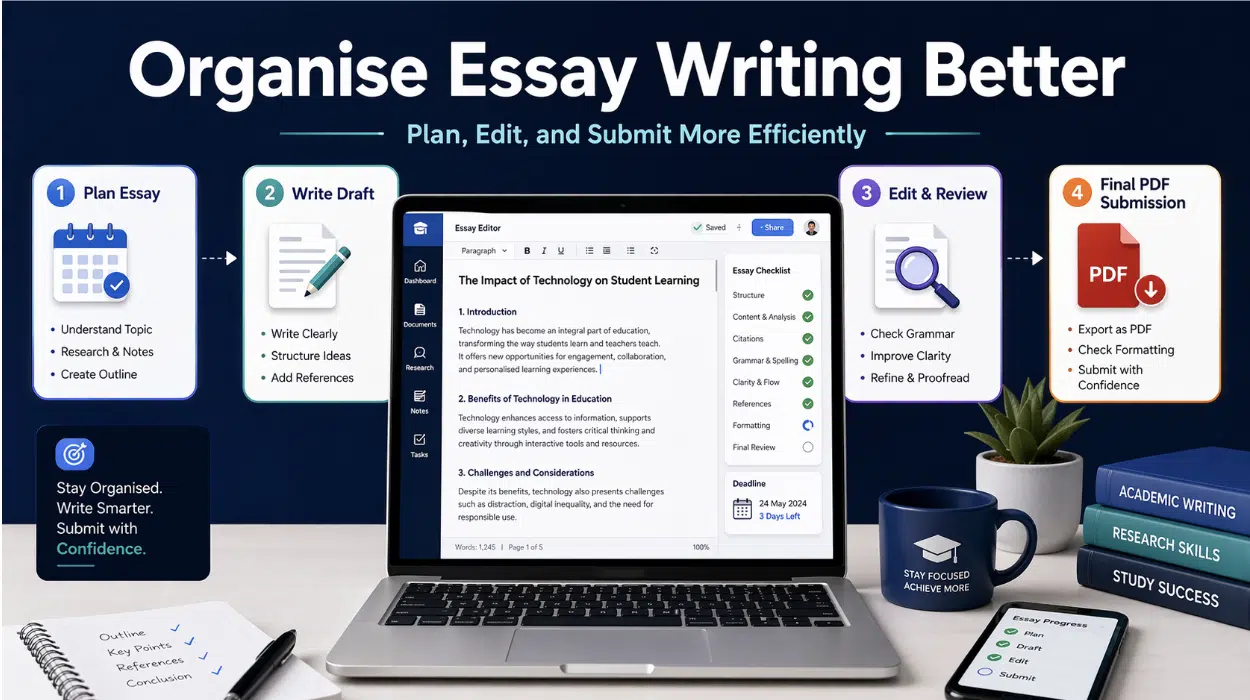
That is why many students feel busy all day and still end up feeling behind. The issue is often not effort. The issue is that planning, drafting, editing, and final submission are happening in the wrong order. Once those parts are separated properly, the work becomes easier to manage and the final essay usually becomes stronger as well.
This guide explains how students can organise the full essay process more efficiently, from the first planning stage to the final submission stage. It focuses on practical workflow, cleaner writing habits, and a better sequence so that the essay does not turn into one rushed task at the end.
A lot of students begin with the assumption that writing should start as soon as the topic is given. That sounds productive, but it often creates extra work later. When the structure is unclear at the beginning, the draft becomes harder to control, and editing turns into a much bigger job than it needed to be.
This is why the order matters so much. Writing is a process that moves through clear stages rather than one continuous rush, and that idea fits essay work very well. A student who separates planning from drafting and drafting from proofreading usually wastes less time fixing preventable problems later in the process.
We make sure our interpretations are:

The first useful step is not writing the introduction. The first useful step is getting the question clear and deciding what the essay actually needs to do. Once that part is stable, everything after it becomes easier to organise.
A good plan does not need to look complicated. It only needs to give the essay a direction. Planning and outlining help writers understand how the parts of a paper will fit together before the full draft begins. That matters for students because a rough structure early on often prevents major rewriting later.
What to Do in the Planning Stage
This stage does not need to take forever. It only needs to remove confusion before the draft begins.
A draft becomes harder to finish when every sentence is treated like the final version. Many students stop after each paragraph, rework the wording immediately, then lose the flow of the argument before the full draft is even complete. That is one reason essays start feeling heavier than they need to feel.
The drafting stage works better when the main goal is movement. The argument has to exist before it can be refined. Some students treat editing and proofreading as separate tasks that come later, which is useful here because students often mix all stages into one and then wonder why progress slows down so quickly.
What Helps During the Drafting Stage
A rough but complete draft is usually more useful than a polished first page with no full argument behind it.
Once the draft exists from beginning to end, the next job is not correcting every small grammar issue immediately. The stronger move is to check whether the essay still makes sense as a full piece of writing. A student can fix grammar early and still end up rewriting half the structure later if the argument is not arranged well.
This is why editing should begin with structure. Paragraph order, evidence placement, transitions, and the strength of the argument matter before sentence level cleanup. Editing and proofreading are not the same thing, and that distinction helps a lot here because students often start with surface corrections before checking the logic of the essay itself.
What to Check First During Editing
After this stage is stronger, proofreading becomes much more useful because the essay structure is already more stable.
This is the stage many students leave too late. The writing may be finished, but the file is not ready yet. Headings still need one last check, spacing should be reviewed, and the final version should be opened once in the same format that will be uploaded.
This matters because submission problems are often formatting problems, not writing problems. Microsoft explains that exporting a document as PDF is a practical way to create a shareable copy while preserving formatting, which is one reason students often choose PDF for final submission.
For students who write in plain editors or want a direct final export path, an online text to pdf converter can make the submission step easier once the essay content is ready. That is especially useful when the student wants a clean final document without shifting into a bulky document workflow at the last minute.
A quick file check at this stage often prevents avoidable submission mistakes.
Students sometimes treat the file format as a small technical detail, but it has a direct effect on submission quality. A format that looks fine on one device may shift on another, and that can create unnecessary risk right at the end of the workflow.
That is why PDF often becomes the safer final choice for essay submission. It keeps the layout more stable across systems, and it reduces the chance of spacing or structure changing after the file leaves the student’s device. The writing may be the main part of the assignment, but the final file still affects how that work is delivered.
A checklist helps most when the essay already feels finished. At that stage, students often trust memory more than process, and that is exactly when small mistakes slip through. A reference list may still be incomplete, the wrong file may be selected, or the final PDF may never be opened after export.
A short checklist prevents that last minute confusion because it turns the final stage into a sequence instead of a rush. The task no longer depends on remembering everything at once. It depends on checking the same few things in the same order.
Students usually do better when each tool has a clear role instead of trying to solve everything in one place. One tool can help with notes. Another can help with drafting. A separate one can help with grammar review or final export.
The point is not to collect as many tools as possible. The point is to make the workflow easier to manage. A notes tool can keep sources organised. A writing editor can hold the draft. A proofreading tool can help with cleanup. A text to PDF workflow can help with the final version when the essay is ready to submit.
Some students are not only writing essays for submission. They are also building skills for future work in content, publishing, media, or digital communication. That is where process awareness becomes useful beyond the classroom.
Students planning careers in digital publishing or content writing often start noticing how agencies handle writing at scale, manage deadlines, and sometimes even outsource seo services when content demand becomes too large for the internal team. That kind of industry awareness does not change the essay itself, but it does show why organised writing habits matter outside university too.
A lot of essay stress comes from repeated patterns that look small at the start. A student begins drafting without a clear outline, starts proofreading before the argument is complete, or leaves the file export until the last few minutes. None of these mistakes look serious on their own, but together they create avoidable pressure.
These are not difficult problems to fix, but they do need the right order. Once the stages are separated properly, most of this pressure becomes easier to control.
The easiest way is to separate the work into clear stages. Planning should come first, drafting should come next, editing should happen after the full draft exists, and final submission should only happen once the file has been checked properly.
Editing should come first because it focuses on structure, argument, and paragraph flow. Proofreading should come later because it works better once the essay already makes sense as a complete piece of writing.
A PDF usually keeps the document layout more stable across systems. That makes it a safer format for final submission when students want to reduce the chance of spacing or structure changing on another device.
Read the full draft once, check the references, export the final file, and open it again before uploading it. A short final review is often enough to catch the last small issues.
Students usually need a few focused tools rather than one heavy workflow. Notes tools, writing editors, proofreading tools, and a clean PDF export option usually cover the most important parts of the process.
You May Also Like
All work is written by human writers. 100% AI free, guaranteed.
100% money back guarantee if you find plagiarism in our work.
COMPANY DETAILS